Updated September 28, 2026
Most businesses have preventive security tools in place — firewalls, antivirus, multi-factor authentication (MFA). Those tools matter. But they are designed to stop threats at the door, and sophisticated attackers are increasingly skilled at getting past them and hiding inside a network. Managed Detection and Response (MDR) is the layer of security that finds those hidden threats and stops them before they cause damage.
If you lead a business with a lean IT team, or none at all, MDR is how you get round-the-clock threat monitoring, detection, and response without hiring a full security operations staff. Here is what MDR is, how it works, and why it has become a foundational part of a modern security strategy.
What is managed detection and response?
Managed Detection and Response (MDR) is a security service that combines technology with human expertise to actively hunt, identify, investigate, and respond to threats that get past preventive security tools. Unlike antivirus or a firewall, which work to keep attackers out, MDR assumes some threats will get in — and focuses on finding them quickly and eliminating them.
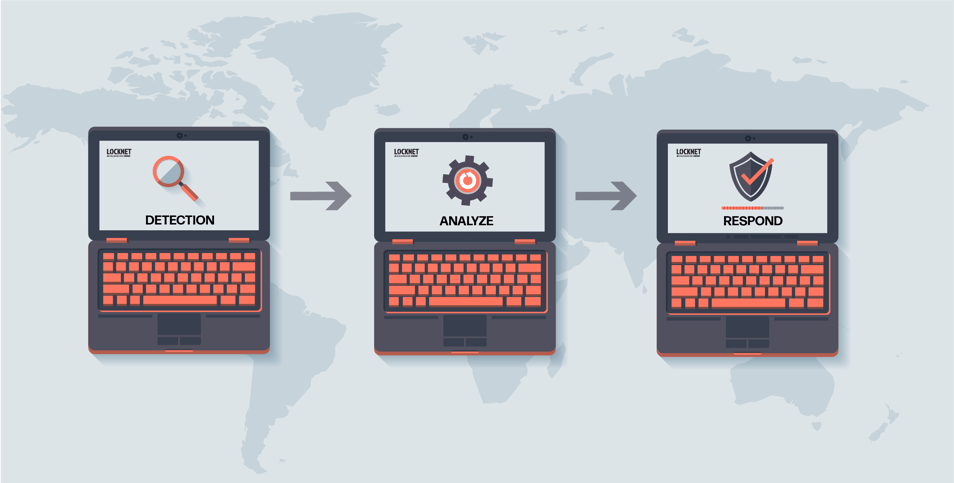
MDR is typically delivered by a Managed Security Service Provider (MSSP) like Locknet® Managed IT. It is built around three core steps:
Detect
Attackers often abuse legitimate applications and processes to bypass security systems and establish a quiet foothold inside a network. MDR monitors your environment around the clock to expose this activity and surface "quiet" indicators of compromise that other tools miss.
Analyze
When something suspicious is found, MDR combines automated intelligence with human security expertise to understand the scope and severity of the potential threat. This is where raw alerts become useful, actionable insight — so you know what matters and what does not.
Respond
MDR eliminates threats that are dwelling in your environment through automated response actions and guided remediation steps, and it provides recommendations to harden your security and reduce future risk.
Why preventive security tools are not enough
Traditional security solutions focus on prevention, and you absolutely need them. Firewalls, endpoint protection, and MFA remain essential first lines of defense. But attackers are well aware of these defenses and actively look for ways around them.
Once inside, some attackers lurk and capture sensitive information. Others deploy ransomware. The longer an attacker dwells in your network undetected, the more damage they can do — and the harder and more expensive the recovery becomes.
That is the gap MDR fills. Detection and response security tactics catch what prevention misses, which is why MDR is one of the first solutions to consider when strengthening your security stack.
Who needs MDR?
Network threats are never off the clock, and today more than ever, businesses need round-the-clock protection. For organizations in regulated, high-stakes environments — financial institutions, healthcare clinics, and construction and engineering firms — the margin for error is small. Patient data, financial records, client information, and audit expectations all raise the cost of a security incident.
MDR is valuable for businesses of all sizes, but it is especially practical for organizations that:
- Have a small or nonexistent internal IT team and cannot staff a 24/7 security operation
- Face compliance or audit pressure that requires demonstrable monitoring and response capability
- Have experienced a security incident and want stronger detection going forward
- Want clear accountability from one security-led partner instead of piecing together multiple vendors and tools
What to look for in an MDR partner
Not all MDR services are built the same. When evaluating providers, look for:
- 24/7 monitoring and response. Threats do not keep business hours. Your detection and response coverage should not either.
- Human expertise, not just automation. The strongest MDR services pair technology with skilled security analysts who investigate and validate threats.
- Clear response actions. Ask what happens when a threat is detected — who acts, how fast, and what you are told.
- Experience in regulated environments. A partner who understands audits, compliance expectations, and the realities of your industry can support audit readiness, not just alerting.
- Shared accountability. The right partner works as an extension of your team, sharing responsibility for your security rather than just forwarding alerts.
FAQs about MDR
Ready to find out where hidden threats may be lurking in your environment? Book a Consultation with a Locknet expert to talk through managed IT services for your organization.