Updated January 5, 2026
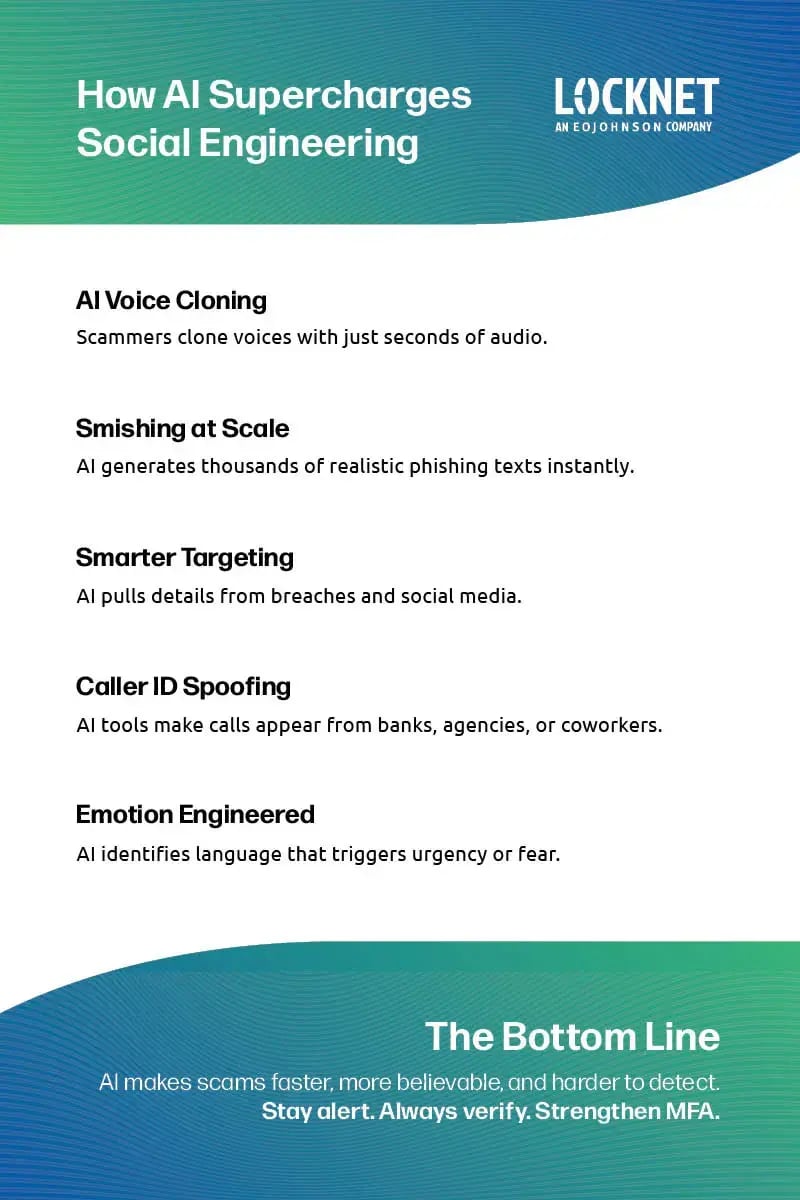
Cybercriminals no longer need to guess what you sound like because they can clone your voice in seconds. They don’t need to hand-craft phishing texts anymore because AI can generate thousands instantly. As social engineering evolves at breakneck speed, vishing and smishing attacks are becoming harder to spot and easier to fall for. In this blog, we’ll break down how these tactics work, how AI is supercharging them, and what you can do to stay ahead of modern scammers.
Understanding the difference between vishing and smishing
While both vishing and smishing are phishing attacks designed to steal sensitive information, they differ in the communication channel.
Vishing
Vishing, short for voice phishing, is a social engineering technique where fraudsters use phone calls or voicemail messages to impersonate legitimate organizations like banks, government agencies, or well-known companies. Their goal is to manipulate victims into divulging sensitive information like passwords, bank account numbers, or Social Security numbers.
What’s new with vishing:
Advances in generative AI allow attackers to clone voices with just a few seconds of audio. These tools have fueled a rise in AI voice-clone vishing scams, where the caller sounds exactly like a family member, executive, or trusted representative. This makes detecting fraud far more difficult than in past years.
Smishing
Smishing (SMS phishing) involves deceptive text messages meant to lure recipients into clicking malicious links or providing personal information. These messages often appear to come from delivery companies, banks, or government agencies.
What’s new with smishing:
Carriers and security platforms have deployed advanced SMS filtering and machine-learning detection, but criminals adapt quickly and are using shortened URLs, rotating numbers, and conversational-style messages that evade automated systems.
Common vishing and smishing scams
Be on the lookout for these evolving tactics.
Fake bank calls
A fraudster impersonates a bank representative and claims suspicious activity on your account. With AI voice tools, they may even replicate the tone or style of your actual banker.
Real-world AI voice-clone scams
Scammers have begun using AI to clone a loved one’s voice, often a child or spouse, claiming an emergency that requires urgent financial help. In organizations, executives' voices are cloned to pressure employees into transferring funds.
Technical support scams
A caller claims to be from a well-known tech company offering help with a nonexistent issue. Victims may be asked to install remote-access software or reveal login credentials.
Contest winnings
A text message promises a prize or reward but requires providing personal information or paying a processing fee. These scams prey on excitement and urgency.
Shipping confirmations
Attackers send fake delivery notifications with malicious tracking links. Modern variants use language that mimics the victim’s real shopping habits.
Government agency threats
Scammers pose as the IRS, Social Security Administration, or other agencies, demanding immediate payment or personal information under threat of legal action.
7 tips to protect yourself from vishing and smishing
Given the increasing sophistication of these scams, it's crucial to stay vigilant and take proactive steps to safeguard your personal information and finances.
1. Verify caller identity
with AI voice cloning and spoofing on the rise, never trust caller ID alone.Hang up and call back using an official phone number.
2. Beware of urgency or pressure tactics
Scammers rely on emotional manipulation. Any demand for immediate action or financial transfer should raise red flags.
3. Avoid clicking suspicious links
If you receive a text with a link, verify its legitimacy through official websites or apps - not through the message.
4. Harden your Multi-Factor Authentication (MFA)
Opt for hardware keys or app-based authenticators instead of SMS codes whenever possible. SMS-based MFA is more susceptible to smishing and SIM-swap attacks.
5. Take advantage of updated SMS filters and security tools
Keep your mobile OS and security apps updated so they can leverage adaptive phishing detection, spam filtering, and link-scanning technologies.
6. Protect your personal information
Do not provide Social Security numbers, account numbers, passwords, or verification codes to unsolicited callers or texters.
7. Educate yourself and others
AI-enhanced scams are spreading rapidly. Share what you learn with employees, friends, and family.
Stay vigilant!
Vishing and smishing continue to grow more sophisticated and are now supercharged by AI-driven voice cloning and adaptive phishing techniques. By understanding these evolving threats and implementing proactive security measures, you can significantly reduce your risk of falling victim.
As part of our managed IT services, the team at Locknet can provide a comprehensive security assessment and employee cybersecurity education strategy. After all, your cybersecurity defenses are only as strong as your weakest link.