Organizations in regulated industries face a perfect storm with a rapidly expanding threat landscape, increasingly complex compliance requirements, and persistent shortages of skilled cybersecurity professionals. For IT leaders and executives operating with limited resources, traditional security models built around on‑premises tools and in‑house teams are becoming harder to sustain.
At the same time, cyberattacks are growing more sophisticated and frequent, targeting everything from endpoints to identities. These pressures are driving a fundamental shift in how organizations protect their environments. This shift moves away from fragmented, tool‑centric approaches and toward security as a service models designed for scale, resilience, and continuous oversight.
What Is Security as a Service (SECaaS)?
Security as a Service (SECaaS) is a cloud‑based, subscription‑driven model in which cybersecurity capabilities are delivered and managed by a third‑party provider. Instead of purchasing, deploying, and maintaining security hardware and software on‑premises, organizations consume security services like monitoring, threat detection, and compliance support on demand.
In simple terms, what is security as a service? It is the outsourcing of some or all security functions to specialized providers who deliver protection, expertise, and technology through the cloud.
Unlike traditional security models that rely heavily on internal investment and staffing, security as a service emphasizes operational flexibility, continuous updates, and access to dedicated security professionals. This makes SECaaS particularly attractive to organizations that need strong security outcomes without building large in‑house teams.
How Security as a Service Works
Most security as a service providers operate on a subscription or managed service basis. Customers pay a predictable monthly or annual fee based on usage, scope, or number of users and devices.
Behind the scenes, providers deploy cloud‑based platforms, sensors, and agents that integrate with an organization’s network, endpoints, and cloud environments. Security operations such as log analysis, threat detection, and incident response are handled by the provider’s security operations center (SOC), typically on a 24/7 basis.
This approach allows organizations to offload day‑to‑day security operations while retaining visibility, reporting, and control aligned to business and compliance needs.
Types of Security as a Service
SECaaS is not a single service, but a broad category that includes multiple security functions:
Network Security as a Service
Network security as a service protects traffic across on‑premises and cloud environments using tools such as firewalls, intrusion detection and prevention systems, secure web gateways, and Zero Trust network access.
Cloud Security as a Service
Cloud security as a service focuses on securing cloud infrastructure, applications, and data. This includes configuration management, workload protection, and continuous monitoring of cloud environments.
Endpoint and device security
Managed endpoint detection and response (EDR) and mobile device security help protect laptops, servers, and mobile devices against malware, ransomware, and advanced threats.
Identity and access management (IAM)
IAM services manage user identities, authentication, and access controls, helping organizations reduce the risk of credential‑based attacks and meet regulatory requirements.
Data loss prevention (DLP)
DLP services monitor and control how sensitive data is accessed, shared, and stored, supporting compliance with regulations such as HIPAA, PCI DSS, and GDPR.
Security monitoring and SIEM
Managed SIEM and security monitoring services collect and analyze logs from across the environment, providing real‑time threat detection, alerting, and compliance reporting.
Benefits of Security as a Service
For organizations with limited IT resources, SECaaS offers several compelling advantages:
1. Cost efficiency and scalability
Security as a service replaces large upfront investments with predictable operating expenses. Services can scale up or down as the organization grows or regulatory demands change.
2. 24/7 monitoring and expertise
SECaaS provides access to experienced security professionals around the clock, providing a level of coverage that is difficult and costly to maintain internally.
3. Faster deployment and updates
Cloud‑based security services can be deployed quickly and updated continuously, reducing exposure to emerging threats.
4. Improved compliance posture
Many providers align their services to regulatory frameworks, helping organizations demonstrate compliance through standardized controls, reporting, and audits.
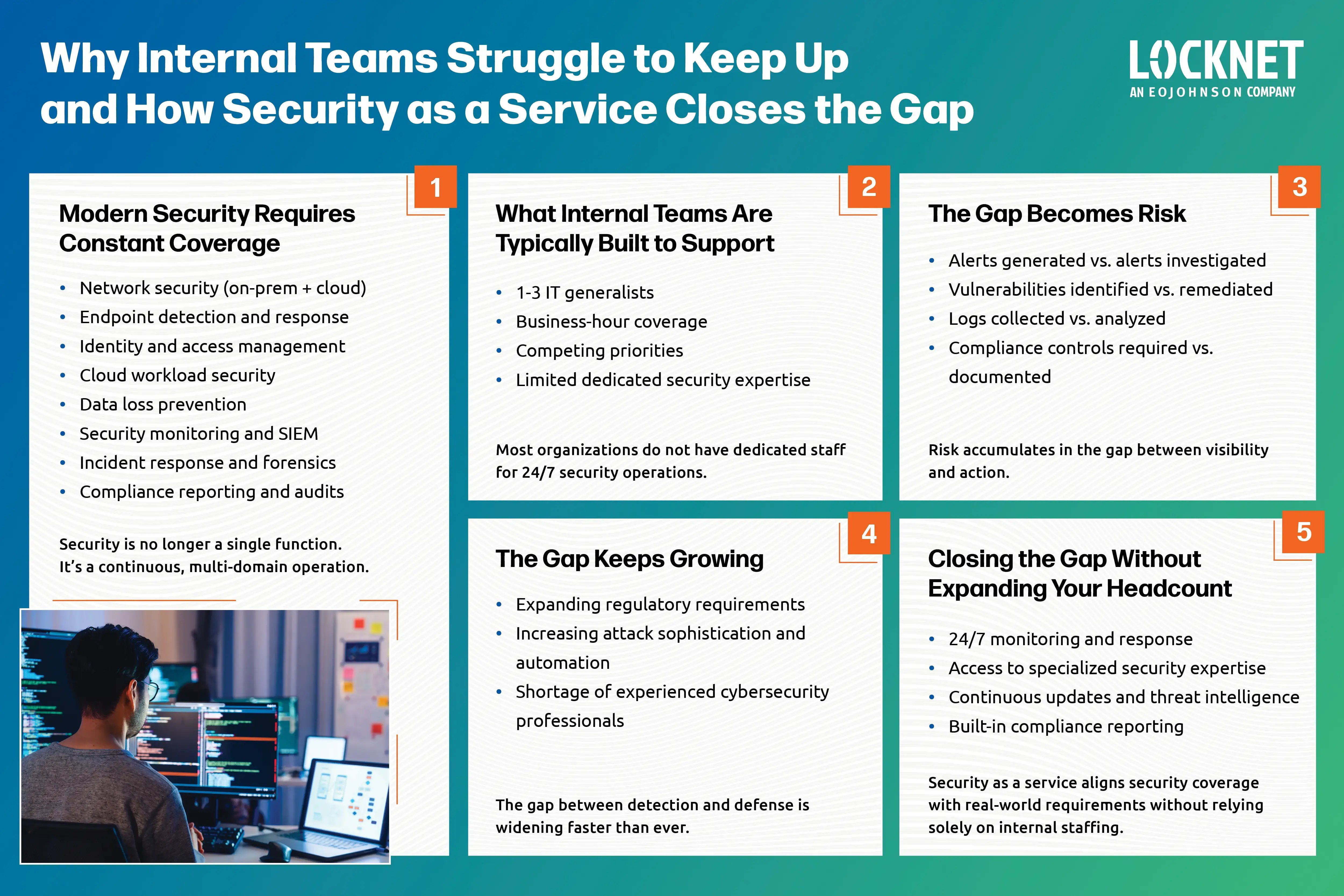
While the benefits of security as a service are compelling, many organizations struggle not because they lack awareness but because internal teams are stretched beyond what modern security demands. The gap between required coverage and available resources is where risk quietly accumulates.
Who should use Security as a Service?
SECaaS is well suited to both small and mid‑sized organizations and larger enterprises seeking to augment internal teams. It is particularly valuable for industries with high compliance and risk exposure, such as healthcare, financial services, and construction.
Choosing the right Security as a Service provider
When evaluating security as a service providers, IT leaders should look for:
- Proven experience in regulated industries
- Clear alignment with compliance requirements (HIPAA, PCI DSS, SOC 2, GDPR)
- Transparent service level agreements (SLAs)
- Strong reporting and visibility
Key questions to ask include how incidents are handled, how data is protected, and how services will integrate with existing tools.
Final thoughts on Security as a Service
As threats intensify and regulatory expectations grow, security as a service has become a practical and strategic approach for modern organizations. By combining advanced technology with expert oversight, SECaaS helps IT leaders strengthen security, improve compliance, and focus limited resources on core business objectives.
Ready to Enhance Your Security? Discover how Locknet’s managed IT solutions as a Managed Security Service Provider (MSSP) can safeguard your business and ensure compliance. Contact us today to schedule a free security consultation or learn more about our tailored MSSP offerings.