Updated February 23, 2026
In 2024, our advice around deepfakes focused on spotting the glitch. Things like awkward eye blinks, strange audio artifacts, or slightly off facial movements. In 2026, that guidance is no longer enough.
AI agents can now generate high‑fidelity voice and video in real time, enabling attackers to impersonate executives, patients, doctors, project managers, and clients with unsettling accuracy. The uncomfortable truth is that we must now assume that any unverified digital interaction could be synthetic.
Deepfake protection is now about identity‑first security, operational discipline, and building organizations that verify before they trust.
The statistical reality of deepfake threats
As deepfake technology becomes increasingly sophisticated, organizations and individuals face a rapidly evolving threat landscape. Recent insights from security.org highlight that the prevalence and realism of AI-generated voice and video attacks are making it more difficult than ever to distinguish genuine interactions from synthetic ones, underscoring the urgent need for robust verification and defense strategies.
- 70% of people said they aren’t confident they can tell the difference between a real and cloned voice.
- Three seconds of audio is sometimes all that’s needed to produce and 85% voice match.
- CEO fraud targets at least 400 companies a day.
- More than 50% of leaders admit that their employees don’t have training on recognizing or dealing with deepfake attacks.
- More than 10 percent of companies have dealt with attempted or successful attempts at deepfake fraud.
From deepfake detection to deepfake protection
Traditional deepfake detection strategies like analyzing facial movements, audio mismatches, or visual artifacts are increasingly unreliable.
Today’s threat landscape is defined by:
- Real‑time voice cloning that can convincingly mimic executives or clients during live calls
- AI‑driven social engineering that adapts tone, urgency, and language on the fly
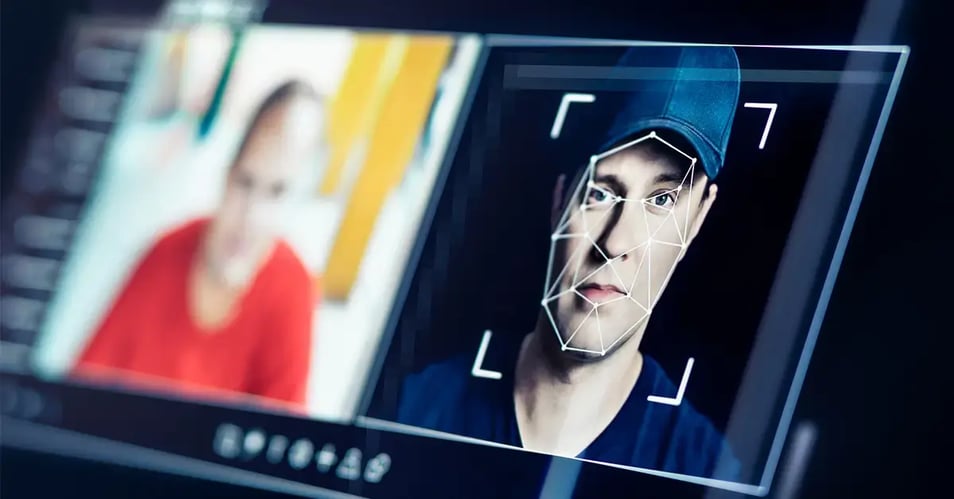
- Biometric identity fraud that uses synthetic faces and voices to bypass identity checks entirely
Given the sophistication of today’s AI threats, the question is no longer whether we can spot a fake but how we independently verify and validate every critical request. With this new reality in mind, it’s essential to examine how these challenges impact industries where trust and security are paramount.
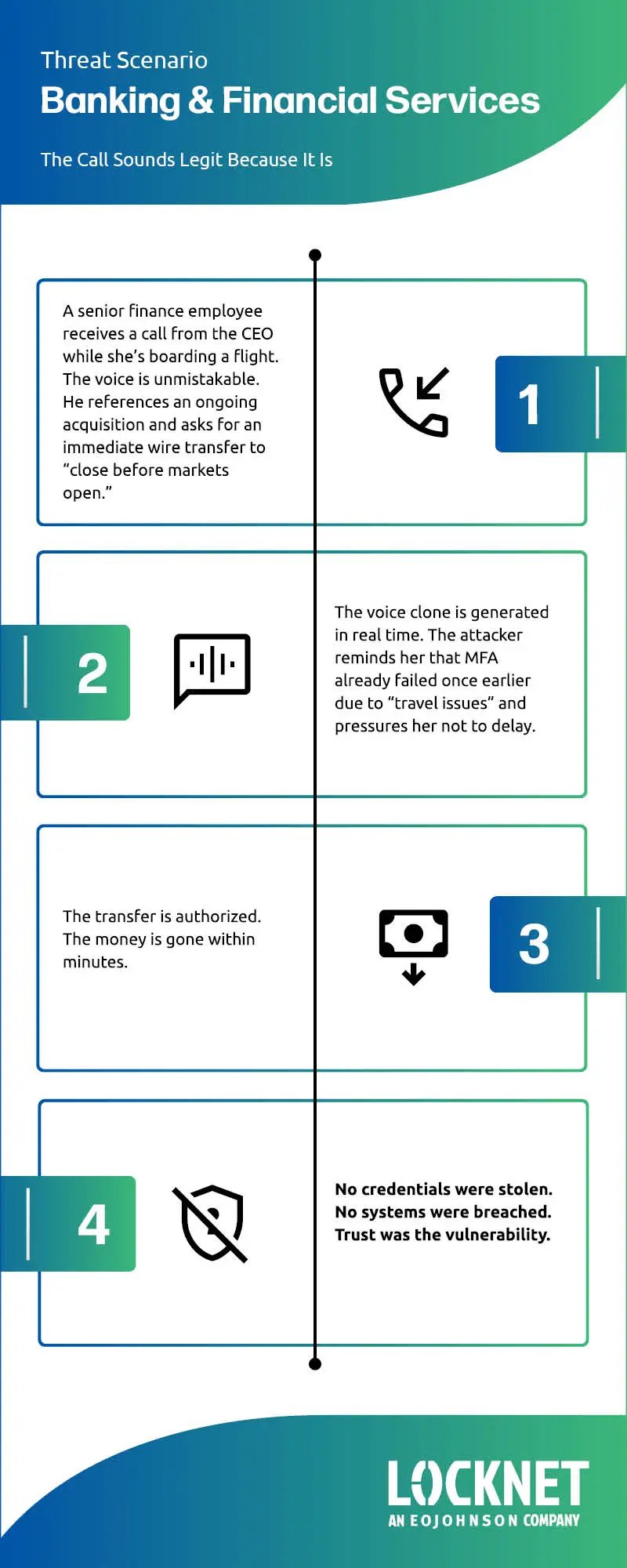
Banking and financial services: combating voice cloning and synthetic identity theft
Financial institutions remain prime targets for deepfake‑enabled fraud, particularly when trust, speed, and authority intersect.
Authorized wire transfer fraud
In 2026, attackers no longer need to steal credentials. Instead, they convince authorized employees to move money on their behalf.
Common scenarios include:
- A voice‑cloned “call from the CEO” demanding an urgent wire transfer
- A synthetic client video call instructing relationship managers to bypass normal multi-factor authentication (MFA) steps
Because the request appears legitimate and comes from a familiar voice, traditional safeguards fail.
Synthetic identity fraud
Deepfakes now play a major role in synthetic identity fraud, where attackers combine real and fake data to open fraudulent accounts. AI‑generated faces pass selfie checks, and cloned voices defeat call‑center verification, leading to long‑term financial losses that are difficult to trace.
For banks, deepfake protection must extend beyond authentication into transaction verification and behavioral controls.
Healthcare vigilance: protecting telehealth and medical records
Healthcare’s rapid adoption of telehealth has created new identity risks with serious regulatory consequences.
Deepfakes in telehealth
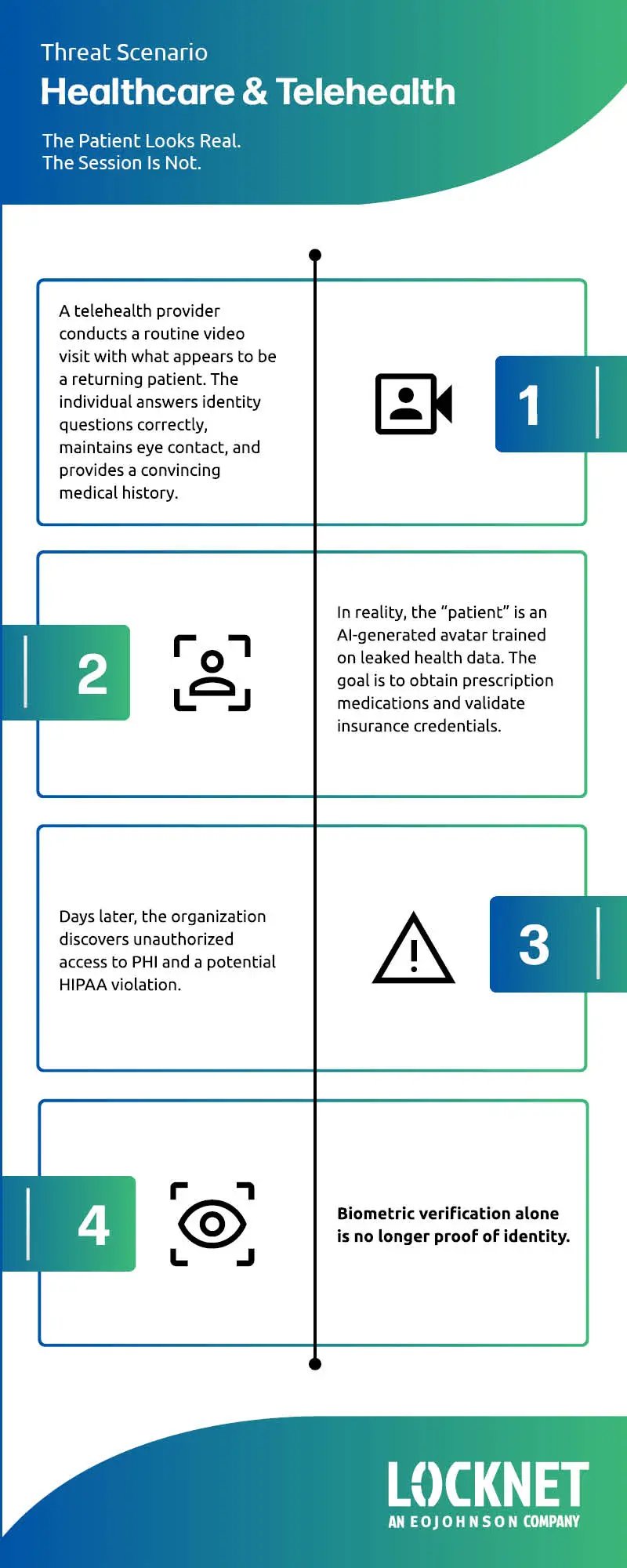
As telehealth adoption grows, so does the potential for identity-based fraud. While large-scale documented cases remain limited, security experts warn that deepfake and AI avatar technologies could be leveraged in healthcare environments in several ways. Here are a few possibilities:
- Impersonating patients during virtual visits to fraudulently obtain prescriptions or controlled substances.
- Impersonating clinicians or trusted staff to manipulate workflows or gain unauthorized access to electronic health records (EHRs).
These types of attacks could threaten not only patient safety, but also organizational compliance.
HIPAA in an AI‑driven world
HIPAA assumes that covered entities can reliably verify identity. In a world of biometric identity fraud, that assumption no longer holds.
Failing to verify who is on the other end of a telehealth session can result in unauthorized disclosure of PHI, regulatory penalties, and reputational damage. Healthcare organizations must treat identity verification as a clinical safety issue, not just an IT concern.
Construction and engineering: Securing the supply chain from impersonation fraud
Construction and engineering firms manage high‑value projects, complex vendor networks, and proprietary designs which make them ideal targets for AI‑driven social engineering.
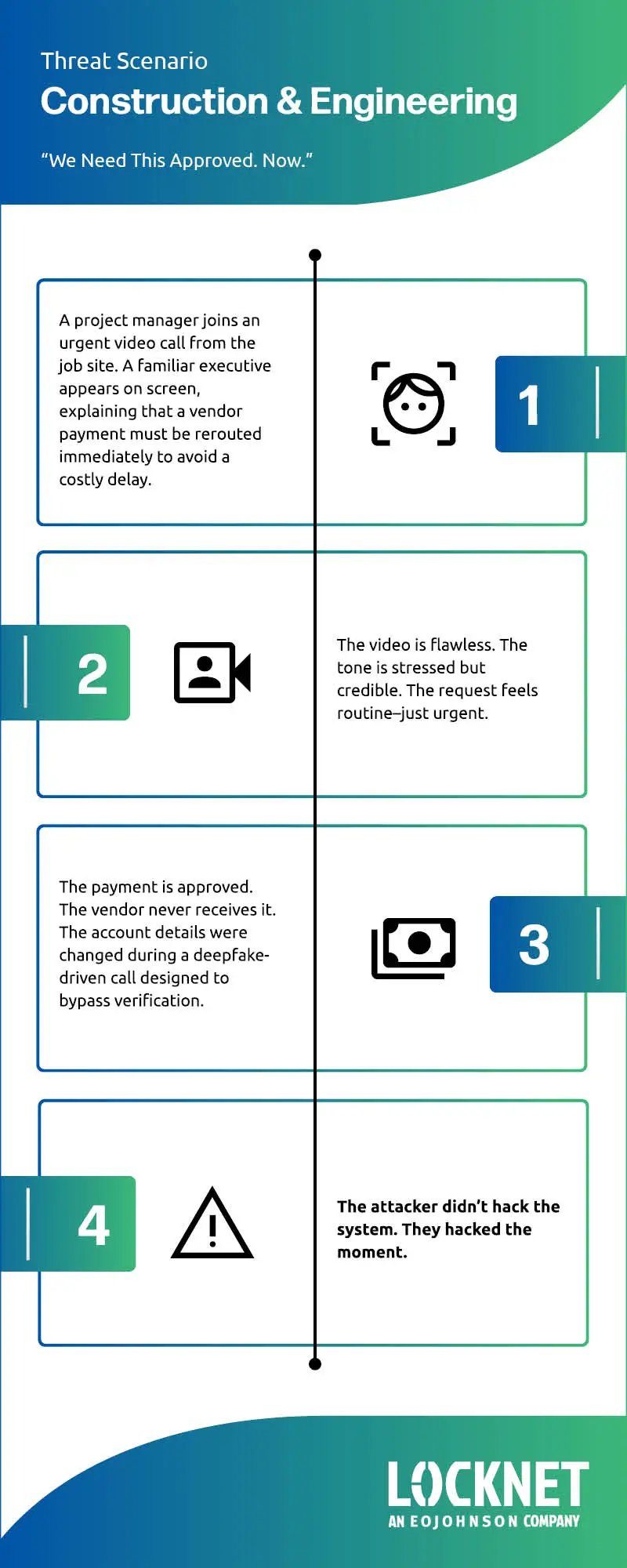
Procurement and payment fraud
In 2026, attackers routinely impersonate:
- Project managers authorizing last‑minute payment changes
- Vendors requesting updated money wiring instructions
- Executives approving emergency procurement decisions over video calls
Because these interactions often occur under time pressure, they are especially vulnerable to manipulation.
The urgency trap
Deepfakes excel at creating a false sense of crisis such as a delayed shipment, a safety incident, or a project‑critical deadline. This urgency trap is designed to bypass verification protocols, particularly on busy job sites where speed might be valued over scrutiny.
Simple steps to protect your organization
Staying safe from new AI-powered scams and deepfakes means everyone in your organization must help. The shift to Zero Trust and identity management are critical with AI-driven social engineering. It’s not just about technology habits but also making sure you trust only what you can verify.
Three things everyone in your organization should do for deepfake protection:
- Always double-check requests—If someone asks for money, data, or access (especially by email, call, or text), confirm in a different way before you respond. For example, call them on a known number or ask in person if possible.
- Don’t rush with important decisions—If a message feels urgent or tries to pressure you, pause. Take a moment to make sure it’s real. It’s better to be late than to fall for a scam.
- Practice staying alert—Train together using simple role-plays like what would you do if you got a strange request? Talk about it in team meetings so everyone feels ready and confident to ask questions.
Simple identity management controls that make a big difference:
- Use a second way to check—Always have a backup way (like a phone call you make yourself) to confirm anything important.
- Shared secret code or question—Pick a word or question only your team knows. If you’re not sure who you’re dealing with, ask for it to make sure the person is really who they say they are.
- Use simple security keys if possible—Some organizations use small security devices that plug into your computer. These help prove you are really you and can’t be faked by hackers or AI.
The main idea is “don’t trust and always verify.” Normalize verification for your employees even when it feels awkward. Help them slow down, check twice, and keep each other safe. Even if your team isn’t made up of tech experts, these habits make a huge difference.
Moving beyond the glitch
Deepfake protection requires a fundamental shift in mindset away from simple detection and toward resilient identity verification, Zero Trust principles, and a workforce trained to challenge what they see and hear.
In 2026, security isn’t about recognizing what’s fake. It’s about ensuring that what matters is always verified.
Looking to strengthen your organization’s defenses against the latest threats? Partner with us for comprehensive managed security and IT expertise. Contact our team today to learn how we can help you verify, protect, and future-proof your business.