Updated December 8, 2025
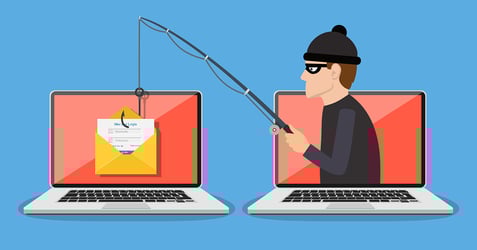
A pharming attack is a sophisticated cyberattack that silently redirects users from a legitimate website to a spoofed, malicious one - often without any clicking, phishing email, or user error. While phishing relies on deception to lure someone into taking an action, pharming alters the path between the user and the website itself.
With today’s rise in Domain Name System (DNS) manipulation, DNS cache poisoning, and AI phishing attacks, pharming has evolved into a major threat to any organization handling sensitive data.
Modern pharming attacks are engineered to steal login credentials, financial information, session cookies, and identity data. In some cases, they also deploy malware for long-term access.
Pharming vs. phishing: what’s the difference?
Although both attacks aim to steal information, they operate differently:
Phishing
- Phishing relies on deceptive emails, texts, or messages.
- Users are tricked into clicking a malicious link or downloading malware.
- Increasingly enhanced with generative AI phishing attacks that mimic human tone, corporate branding, and even employee writing styles.
Pharming
- Doesn’t require a lure, but phishing may be used to plant malware that enables pharming later.
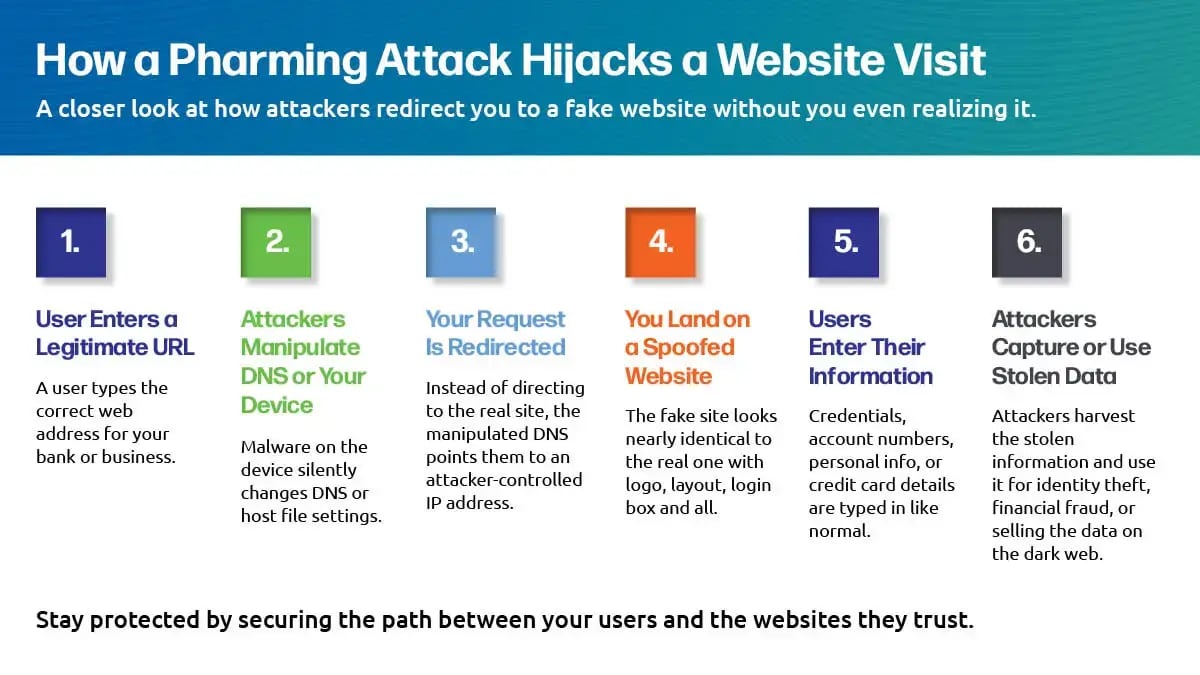
- Redirects a user to a spoofed website automatically using DNS manipulation or malicious host file changes.
- Users may type the correct URL but still land on a fraudulent page.
In short, phishing targets people and pharming targets the infrastructure that directs people online. A pharming attack doesn’t necessarily need a phishing lure to get started. Instead, it just plants a seed you don’t know is there and harvests the user’s information later.
How do pharming attacks work?
Pharming is a sophisticated cyber-attack that requires more work from the cyber criminals, making them less common than phishing attacks. None the less, the impact of a pharming attack can be significant. Typically, pharming uses one of the following techniques:
- Malware infection. Malware in the form of viruses or trojans execute pharming attacks by infecting a computer or network, altering DNS settings, or manipulating the host’s file. Users trying to access a legitimate website are unknowingly redirected to a malicious one instead.
- Host file modification. The local file on a computer that maps domain names to specific IP addresses is modified to redirect to the malicious website.
- DNS cache poisoning. Vulnerabilities in the DNS are exploited, and the DNS cache is poisoned, so attackers can manipulate the mapping between domain names and IP addresses. DNS cache poisoning is one of the most dangerous pharming tactics because it affects entire networks, not just individual users.
- Rogue DNS servers. Cybercriminals deploy rogue DNS servers that return fake IP addresses for legitimate domains and silently reroute traffic to attacker-controlled websites.
Once users are redirected to fraudulent websites, pharmers obtain personal information. The attackers then either use the credentials for financial fraud or account access. They may also sell the information to other criminals on the Dark Web.
Why AI makes pharming even more dangerous
AI has changed the cybersecurity landscape in ways that directly amplify pharming threats:
- Hyper-realistic spoofed websites: AI-generated content and images make fraudulent websites nearly indistinguishable from real ones.
- AI-driven phishing precursors: Attackers can use AI to deliver highly convincing phishing emails that plant malware enabling later pharming attacks.
- Automated credential harvesting: AI tools can parse stolen form entries in real time and test them across multiple accounts.
- AI-powered evasion techniques: Malicious website scripts can detect security tools, endpoints, or automated scanners.
The combination of DNS manipulation + AI phishing + advanced spoofing makes pharming attacks more scalable and more difficult to detect.
Real-world pharming attack examples
So, what does a pharming attack really look like? Here are just a few notable real-world examples of pharming.
- Large-scale banking attack. In 2007, over 50 financial institutions across the US, Europe, and Asia were targeted. The sophisticated attack created an imitation web page for each targeted financial company using a combination of malware and DNS server poisoning.
- Brazil’s phishing and pharming attack. In 2015, attackers sent phishing emails to users of Brazil’s largest telecom company. Links in the emails downloaded pharming malware which allowed attackers to exploit vulnerabilities and change their routers’ DNS server settings.
- Venezuelan volunteer attack. In 2019, hackers attacked a Venezuelan volunteer organization, directing users to a fake website and stealing their personal information.
These incidents highlight how pharming can exploit both consumer hardware and enterprise infrastructure.
How organizations can prevent pharming attacks
Given the growing sophistication of pharming attacks, it’s essential for organizations to take proactive steps to defend their networks and users. Below are some effective strategies that can help reduce the risk of falling victim to these threats.
1. Use a Zero Trust browser or browser isolation
Modern Zero Trust browser controls:
- Prevent redirection to malicious domains
- Enforce URL filtering
- Block unauthorized scripts
- Isolate risky web activity
Modern browser security controls stop pharming even when DNS is compromised.
2. Harden DNS Infrastructure
- Use reputable DNS providers with built-in threat filtering.
- Deploy redundant DNS servers.
- Regularly audit DNS records for unauthorized changes.
3. Keep systems patched
Most pharming malware exploits outdated software. Consistent patching reduces the attack surface significantly.
4. Require Multi-Factor Authentication (MFA)
Even if credentials are stolen, MFA can stop attackers from gaining access.
5. Use encrypted browsing (HTTPS Everywhere)
Verify certificates and block sites with invalid or suspicious SSL certificates.
6. Secure routers and network devices
- Change default router passwords.
- Update firmware regularly.
- Disable remote management unless required.
7. Strengthen security awareness training
Conduct regular security awareness training so employees know how to:
- Identify a spoofed domain
- Spot suspicious browsing behavior
- Recognize AI-enhanced phishing attempts
- Report incidents quickly
Human awareness remains one of the strongest defenses.
FAQs for pharming attacks
What is a pharming attack?
A pharming attack is a cyberattack that redirects users from a legitimate website to a fraudulent one - often using DNS manipulation, DNS cache poisoning, or malware to alter system routing.
How does DNS manipulation enable pharming?
DNS manipulation corrupts the translation between domain names and IP addresses. When users attempt to load a legitimate site, the manipulated DNS directs them to a spoofed site controlled by attackers.
How does AI make phishing and pharming attacks more dangerous?
AI enables attackers to create convincing phishing emails, realistic spoofed websites, and automated credential-harvesting tools which make pharming campaigns more scalable and harder to detect.
How can organizations prevent pharming attacks?
Organizations can prevent pharming by securing their DNS infrastructure, enforcing Zero Trust browser controls, patching systems, enabling MFA, and maintaining ongoing security awareness training.
Final thoughts on pharming attacks
Pharming attacks are evolving quickly, but with modern DNS protections and smarter web security controls, organizations can stay a step ahead. Strengthening the path between your users and the websites they trust is one of the most effective ways to shut down these threats before they cause real harm.
Ready to strengthen your organization's defenses? Partner with Locknet for comprehensive cybersecurity solutions and expert guidance to protect against evolving threats like pharming. Contact our cybersecurity team today to schedule a consultation and ensure your business stays secure.