
Updated February 9, 2026
If you run a small to medium-sized business in a regulated industry, you already know the stakes are high. You can’t afford a breach, prolonged downtime, or compliance violations. Yet, you may not have the internal IT resources to run a full-time security operations center.
That’s exactly where threat hunting becomes a game-changer, especially when it’s built into a modern managed detection and response (MDR) program. Instead of waiting for alarms to go off, threat hunting helps you uncover suspicious activity that may already be happening quietly inside your environment.
What Is threat hunting?
Threat hunting is the proactive process of searching for signs of malicious activity inside your systems even when no alerts have been triggered.
Unlike traditional monitoring, which responds to known indicators or security alerts, cybersecurity threat hunting is driven by human curiosity, experience, and investigative thinking. Analysts start with a hypothesis (for example: “An attacker may be abusing dormant user accounts”) and then search across network, identity, endpoint, and cloud activity to validate or disprove it.
Think of it as the difference between waiting for a smoke alarm to ring and actively checking your building for hidden fire hazards.
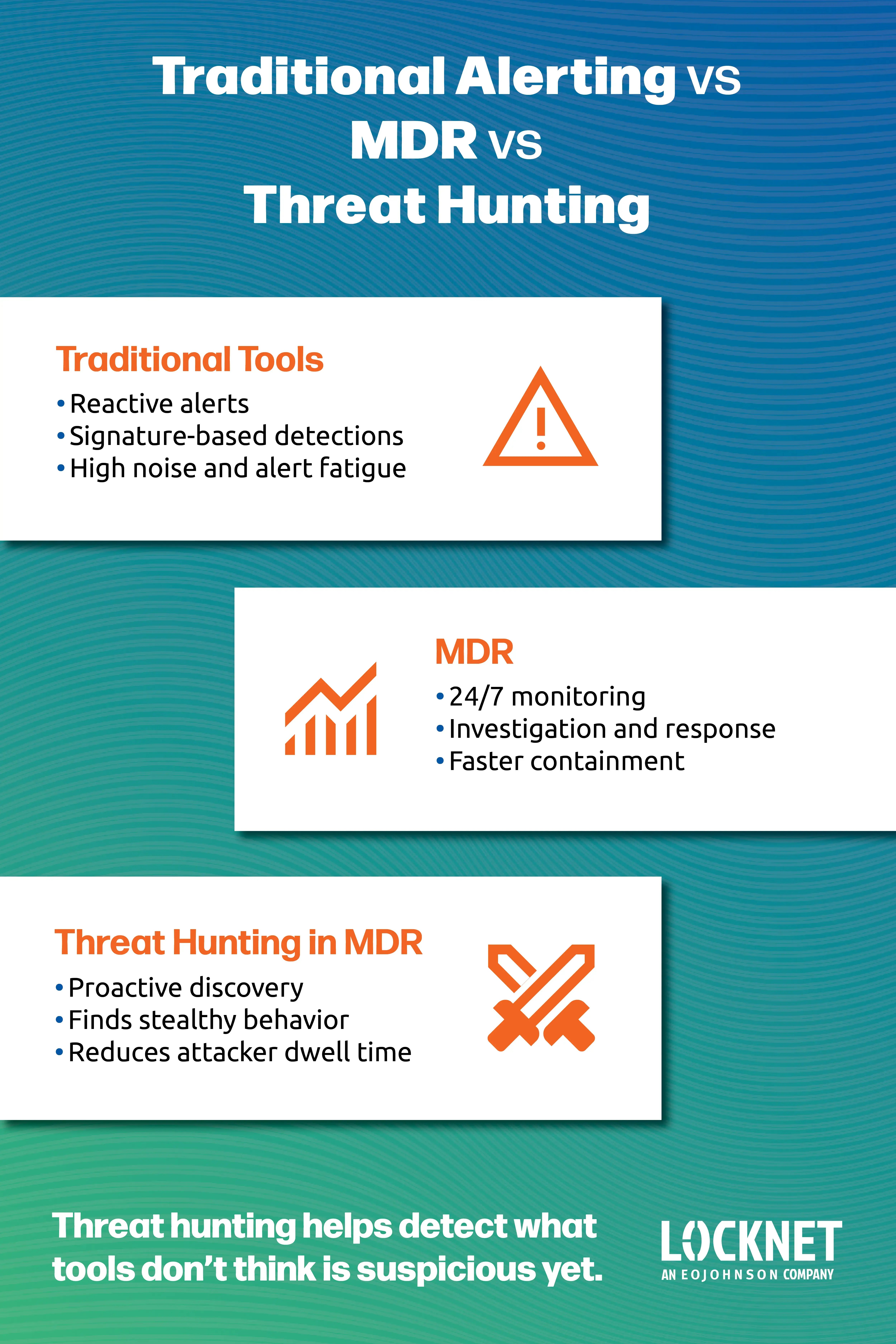
Before we go deeper, it helps to see how threat hunting differs from traditional security alerting and how it fits inside managed detection and response.
Why traditional security tools can miss modern threats
Small and medium-sized organizations often rely on endpoint protection, firewalls, and basic alerting tools. These are helpful, but they can’t catch everything. Modern attackers know exactly how to stay below the radar.
Here’s why many threats slip through:
1) Alert fatigue
Security tools generate enormous volumes of alerts. Many are false positives or low-priority notifications. Over time, teams may get overwhelmed and only respond to the “loudest” signals, leaving quieter threats undetected.
2) Malware-free attacks
Some intrusions don’t rely on obvious malware at all. Instead, attackers exploit valid credentials, remote access tools, or scripting capabilities. These malware-free attacks can blend into normal operations and appear harmless to automated tools.
3) Legitimate tool abuse
Attackers increasingly use “built-in” system utilities or things already installed and trusted in most environments. This style of intrusion is often called living-off-the-land attacks, because the attacker uses what’s already there to move, escalate privileges, and exfiltrate data.
The human role in threat hunting
Threat hunting is not just about technology. It’s about judgment.
In a mature hunting process, analysts bring:
- Hypothesis-driven investigation based on current attacker tactics
- Context and business awareness that automation can’t replicate
- Human-led threat detection to identify patterns that tools may treat as “normal”
Human hunters understand that what’s normal in one company may be suspicious in another. A login at 2 a.m. might be expected for a hospital. For a regional credit union? That could be a red flag worth digging into.
How threat hunting strengthens managed detection and response
Many organizations adopt MDR because they need continuous monitoring, investigation, and response without building a large internal team. But MDR becomes significantly stronger when threat hunting is treated as a core discipline of MDR, not an optional add-on.
Proactive detection vs reactive alerting
A monitoring-only approach waits for detections to fire.
Threat hunting flips that model by asking “What if the detection never triggers?”
This is what makes hunting so powerful for regulated businesses, where threat actors may be persistent, patient, and financially motivated.
With proactive hunting, you can:
- Identify early-stage compromise activity
- Find lateral movement before damage spreads
- Reduce attacker dwell time or how long an intruder remains undetected
The longer an attacker remains in your systems, the more likely they are to access sensitive data, tamper with operations, or establish backup access paths. Threat hunting is designed to shorten that window.
Closing gaps in automated MDR tools
Even the best MDR platforms rely heavily on automation. Automation is critical, but it has blind spots. Managed threat hunting helps close those gaps in areas where attackers often succeed:
- Identity abuse: suspicious sign-ins, credential misuse, privilege escalation
- Cloud and SaaS visibility: activity inside Microsoft 365, Google Workspace, or other business platforms
- Living-off-the-land behavior: legitimate tools used in suspicious sequences
- Behavioral threat detection: subtle patterns that look normal at the event level, but suspicious in context
This is where threat hunting makes MDR truly resilient because it goes beyond alerts and digs into intent.
What modern threat hunting looks like in 2026
Threat hunting isn’t static. Attackers evolve constantly, and defenders must adapt just as fast. In 2026, modern threat hunting is more identity-focused, cloud-aware, and behavior-driven than ever before.
As businesses continue moving into SaaS platforms and remote work, identity has become the most common attack path.
Identity-based threat hunting looks for red flags like:
- Credential misuse from unusual locations
- “Impossible travel” sign-ins
- Repeated MFA prompts consistent with MFA fatigue attacks
- Suspicious sign-in behavior tied to new devices or risky apps
- Privileged accounts behaving abnormally
If attackers can gain access to valid credentials, they can bypass many traditional tools. Hunting helps catch the misuse after access is obtained when automation might still think everything is fine.
Why threat hunting Is critical for businesses of all sizes
A common misconception is that threat hunting is only for large enterprises. In reality, smaller organizations are often more vulnerable because they have fewer internal resources, less dedicated monitoring, and more operational disruption when incidents occur.
Attackers target behavior, not company size
Most modern attacks are opportunity driven. Criminal groups scan broadly for weak points like:
- Unpatched systems
- Poor password hygiene
- Misconfigured cloud services
- Over-permissioned user accounts
Attackers don’t need your business to be large and well known. They only need it to be accessible.
The business impact of undetected threats
When an intrusion is missed, the cost isn’t just financial -it’s operational and reputational.
Long attacker dwell time can lead to:
- Sensitive data exposure (customer, patient, or financial data)
- Compliance reporting requirements
- Business downtime and workflow disruption
- Vendor and customer trust erosion
Threat hunting helps reduce these risks by uncovering hidden activity before it becomes a crisis.
Getting started with MDR and staying vigilant
If your organization is seeking stronger security, faster response, and greater visibility without the need to build an internal SOC, partnering with a modern MDR provider delivers significant advantages.
Stay ahead of the curve on cybersecurity best practices and emerging threats. Download our newsletter to receive the latest updates, expert insights, and actionable strategies that will keep you informed about the evolving landscape of cybersecurity.